
Choosing a dehumidifier for a Hong Kong flat: capacity, label and safe placement
Identify the moisture source and room to be treated before comparing the tested water-removal capacity, energy factor and annual consumption. Leave a safe location and fixed socket; a dehumidifier does not repair a leak.
Define the job before buying a machine
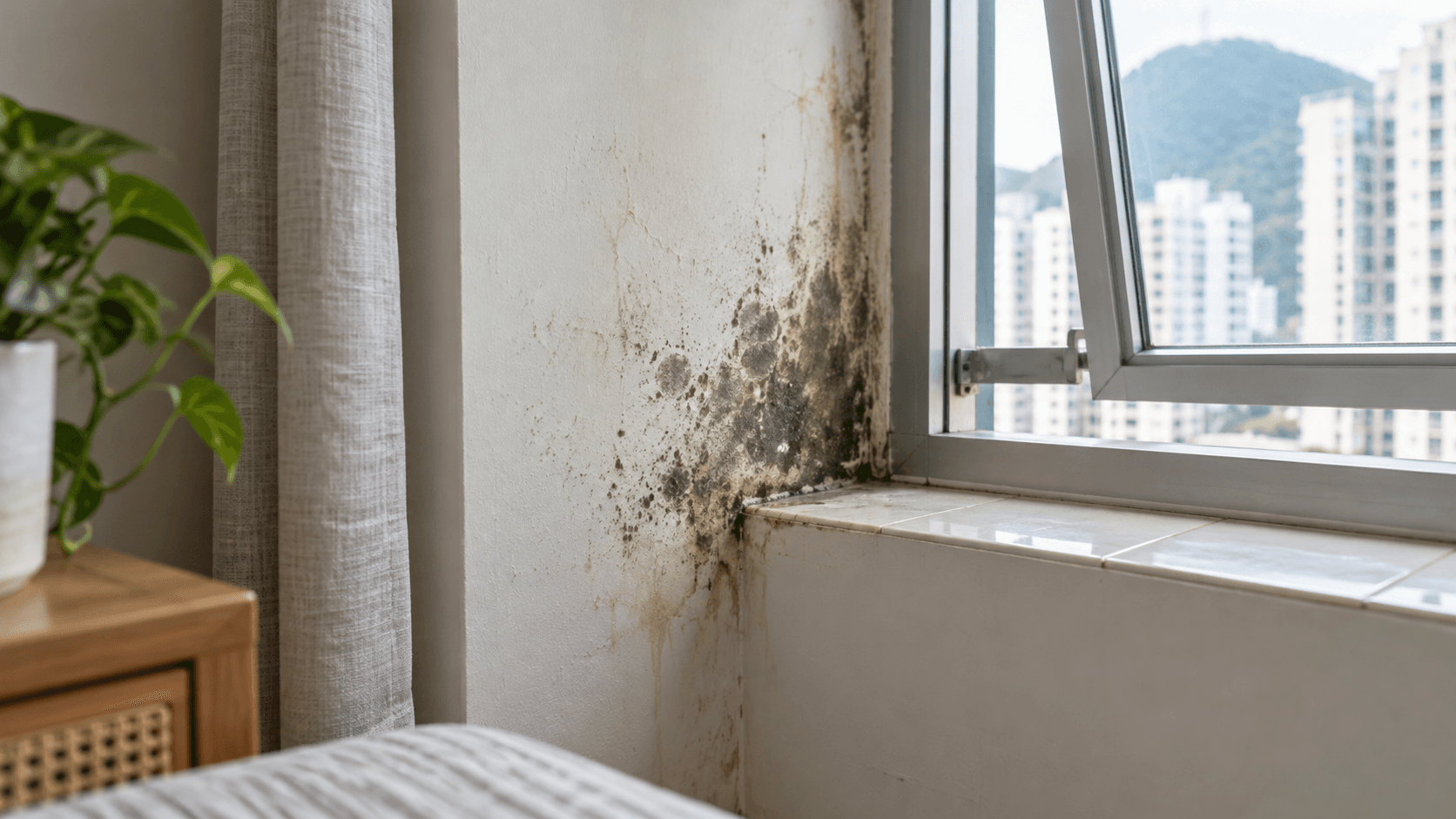
The first question is whether the household is managing seasonal humidity, moisture from indoor drying, or a persistent wet patch beside a window. A dehumidifier can remove moisture from the air in suitable conditions. It cannot repair an external wall, a pipe or a condensation defect that continues to feed water into the room. Where a patch repeatedly grows, paint bubbles or mould returns, record its position and timing, find the source and arrange the appropriate repair. A larger machine should not be used as a reason to postpone that investigation.
Next define the room that will actually be treated, whether its doors and windows can be closed, where a flat stable surface and fixed socket are available, and how the tank will be emptied. EMSD advises matching dehumidifying capacity to room size; greater capacity is not automatically more economical. A bedroom, a living room and an open kitchen present different air volumes and sources of moisture. Treating the gross floor area of a whole flat as though it were one sealed room can distort the comparison. If one machine will move among rooms, check weight, clear routes and safe power at each location.
Read the capacity, factor and consumption together
For covered compression-type dehumidifiers, Hong Kong’s mandatory energy label gives efficiency grade, dehumidifying capacity and annual energy consumption. EMSD says the label figures are measured at a common test condition of 26.7°C and 60% relative humidity to make model comparisons meaningful. Capacity, expressed in litres per day, is the amount of moisture removed under the stated test conditions. It does not promise that the household will pour that volume out of the tank each day in every season. Room temperature, humidity, air movement and operating hours all affect actual collection.
The energy factor is litres of water removed for each kilowatt-hour of electricity under the test condition. A higher factor means greater efficiency on that basis. Labelled annual consumption is also based on the scheme’s test assumptions; it is not a guarantee of your future bill. Grade 1 is the more efficient end of the scale and Grade 5 the less efficient end, but two machines in the same grade can have different capacities and factors. Find the capacity that suits the room first, then compare the factor and annual figure among suitable candidates. That prevents a colourful grade badge from replacing the practical room decision.
Check the technology and exact model
EMSD explains that the current mandatory labelling scheme covers compression-type dehumidifiers, while desiccant-type machines are outside that part of the scheme. A comparison between those technologies cannot treat the presence of a mandatory label on one and its absence on the other as a direct performance ranking. Ask the seller for capacity and consumption information tested on a comparable basis, and acknowledge when the evidence does not permit a precise ordering. Likewise, an unlabelled item is not automatically unlawful merely because another technology uses a mandatory label.
For a covered compression model, match the full brand name, model suffix and reference number on the machine and store label to EMSD’s record. Similar model names can represent different tests or specifications. If an advertisement gives a “maximum extraction” figure different from the Hong Kong label, ask about the temperature and humidity used to obtain the larger number. Do not substitute the most attractive figure for the regulated one without stating its basis. Save the label and full specification before ordering, so that the delivered appliance can be checked against what you actually compared.
Compare the room and operating pattern on one sheet
Imagine candidate A advertises a greater daily capacity, but the household will use it in a small bedroom with a door that can be closed. Candidate B has a capacity closer to the need and offers automatic humidity control. A is not necessarily the better choice because its capacity number is larger. EMSD recommends a suitable capacity and automatic control. Make a comparison sheet with the intended room, safe placement, tested capacity, energy factor, annual consumption, tank emptying arrangement, noise information and ease of cleaning. This is a hypothetical decision method, not a ranking of live products.
Another household plans to run its unit in a combined living and dining room while the windows are often open and cooking continues nearby. That situation differs from the standard label test. Outdoor humid air may continue to enter, so a promise that any machine will dry the entire flat in a set time would be unsound. When dehumidification is needed, close the doors and windows where practical, use the appropriate automatic mode, and observe the room condition. A model should be chosen against a realistic operating pattern rather than an extraction figure from an unspecified test.
Make placement and power a safety check
EMSD’s safety guidance calls for a flat, firm surface and warns against putting a dehumidifier in a bathroom or beneath dripping clothes. The air inlet, outlet and humidity sensor must remain clear. A corner crowded with curtains, boxes or furniture can restrict airflow, though the precise clearance should follow the specific model’s instructions. Plan a route to empty the water tank without carrying it over cables or across a slippery floor. A unit that fits physically but cannot be emptied or cleaned safely is a poor choice for that location.
EMSD also advises using a fixed independent socket, rather than sharing a socket with other appliances or relying on an extension unit. Check this at the intended position before purchasing. If the socket is loose or insufficient, have the electrical situation assessed by an appropriate professional instead of improvising a long lead near the water tank. Follow the maker’s operating instructions. Abnormal noise or smell, overheating or an overflowing tank are reasons to stop using the appliance and arrange inspection. Safety is part of the purchase specification, not a later accessory.
Maintain the machine to keep the comparison meaningful
EMSD recommends cleaning a dehumidifier, particularly its filter, and keeping its air path unobstructed. Make tank emptying, filter cleaning and visible condition checks part of the household routine, following the product manual for method and frequency. An “automatic” setting does not remove the need to look at the tank, cable, plug and appliance condition. EMSD cautions against prolonged use that might lead to overheating; operate the unit according to its safety advice and instructions rather than leaving it indefinitely without attention.
Efficiency also depends on how the room is used. EMSD advises closing doors and windows during operation, placing the unit away from direct sun or heating equipment, and keeping inlet and outlet clear. If moisture originates in a real leak, fixing that source may reduce unnecessary machine use. If the problem is humidity inside a bathroom, do not move the appliance into the bathroom contrary to the safety guidance; investigate ventilation and other safe methods. These conditions influence household electricity use, so the energy label should not be turned into a fixed monthly cost claim.
Ask the right questions when viewing a flat
A dehumidifier in a flat being shown for sale or rent is neither proof of a leak nor proof that the home is dry. Ask where and when the owner uses it, whether there are known water ingress issues and whether dated repair records exist. Inspect accessible window edges, corners and places where condensation might form, and distinguish a recurring damp defect from ordinary seasonal humidity. Record any building or plumbing issue as a separate property decision. If the machine is said to be included in the tenancy or sale, confirm its exact model, present condition and handover terms rather than assuming a viewing prop will remain.
Your final equipment checklist should contain the room to be treated, a suitable fixed socket, a level position away from dripping water and obstructions, the exact official label data where applicable, warranty terms and a practicable cleaning plan. Decide first whether an appliance is the right response to the moisture problem; then compare models that meet the capacity and safety requirements. Houseline listings can help you compare potential homes, but the source of moisture and the safe place for a machine require actual viewing and documentary follow-up.
