
Damp beside a window after rain: management or the Joint Office?
Record the timing and position before deciding whether rain has entered the building fabric or a neighbouring flat may be leaking. Route rain-related fabric checks through management; unresolved suspected flat-to-flat seepage may warrant Joint Office help.
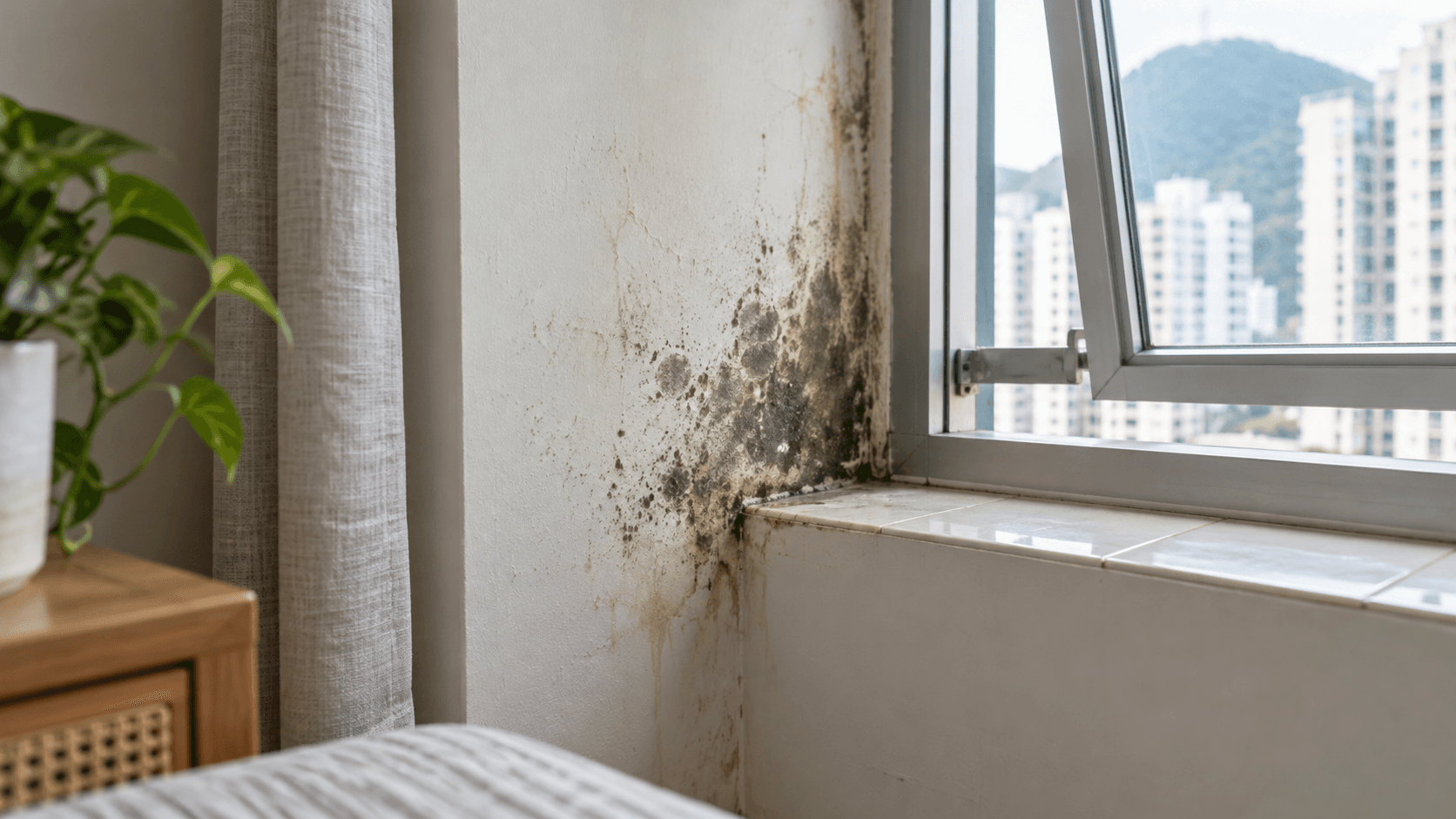
Decide what the pattern actually tells you
A damp patch beside a window after a storm is a reason to investigate the building envelope, not proof that the window is defective. Rain may enter at a frame joint, an external wall, a roof or a balcony and then travel along concealed surfaces before appearing inside. A stain on a ceiling below another flat can instead arise from that flat's supply pipe, drain, sanitary fitting or failed waterproofing. Buildings Department lists all of these as possible causes. The useful first decision is therefore whether the timing points to rain, to a fixture being used, or to a continuous leak. Treat the pattern as a lead rather than a diagnosis. Buildings Department: causes of seepage.
Write down the exact position, the first date noticed, and whether the surface is wet only during or after rain. Note whether the problem appears when a nearby tap or shower is used, whether the stain expands in dry weather, and whether another wall or flat is affected. Take dated wide and close photographs, but do not conceal the patch before a person examining it can see the route. A moisture mark may remain after the active leak has stopped, so compare observations across several conditions. If water is reaching electrical fittings or ceiling material appears unstable, avoid the affected area and arrange urgent professional help; photographs are never a substitute for making a hazard safe.
Route rain entry and suspected plumbing differently
The Joint Office of the Buildings Department and Food and Environmental Hygiene Department investigates seepage that may constitute a hygiene nuisance. Its own FAQ says that rain entering through roofs, flat roofs, balconies, external walls or windows ordinarily has no public health implication under its nuisance procedure and is normally not followed up through that route. It may advise the owners' corporation to have building professionals inspect an exterior wall or roof and registered contractors carry out necessary repairs. If a safety issue emerges, it may refer the matter to Buildings Department. This is a routing rule, not permission to ignore rain entry. A resident facing rain-related damp should promptly notify building management or the owners' corporation and ask who maintains the relevant fabric under the deed of mutual covenant. Buildings Department: rainwater and Joint Office scope.
If the evidence instead suggests an upper or adjacent flat's plumbing, approach that neighbour promptly and ask for investigation and repair. Involve management so that access, shared pipes and observations can be coordinated. The source can also be inside your own flat, so arrange a building technician or licensed plumber where appropriate before accusing another owner. Buildings Department says owners are responsible for maintaining and managing their building and may seek help from management or the owners' corporation. A private investigation, a neighbour conversation and a government nuisance investigation answer different questions. None automatically settles who pays for every repair; the physical source and the building's deed matter. Buildings Department: owner steps and disputes.
Make a repair request that can be acted on
Send management a short report with the flat address, a marked location, the dates and weather pattern, photographs and a request for an inspection. Ask it to identify whether the suspected component belongs to your flat, another flat or the common parts, and to say what document supports that allocation. Request an inspection appointment and a written finding, rather than merely requesting that someone paint over the stain. For a window-side mark, a useful inspection can consider the window frame and seal, wall joints, exterior wall above, nearby balcony and any hidden route. For ceiling seepage below a bathroom, ask the investigator to consider supply, drainage and waterproofing without assuming which one is at fault.
Keep the contractor's proposed test and repair scope in separate columns. A sealant quote, for instance, does not prove that the sealant is the cause; a test may still be needed. Ask what area the contractor can inspect, whether access to another unit or the facade is needed, whether any opening-up is proposed, and how the result will be recorded. Keep photographs before and after repair and check the same place after comparable rain or fixture use. If an initial repair fails, the new observation should update the working diagnosis. In a rented home, tell the landlord or designated contact promptly under the tenancy while also notifying management where common parts may be involved. Avoid agreeing that a particular party is liable merely because that party arranged access.
Know what a Joint Office report can change
If discussion and management do not resolve suspected seepage from another premises, owners or occupants can call 1823 for Joint Office assistance. For reports received from 2026-07-16, the Joint Office applies its new pilot investigation procedure. At Stage I it uses infrared thermography together with an electronic moisture meter to assess seepage and preliminarily identify a source. Where it reasonably believes the upper flat caused it, the Joint Office issues that owner a Notification Letter calling for inspection and repair within 28 calendar days. This letter is an early step, not a final finding of liability. Cases received before 2026-07-16 continue under the previous procedure. Buildings Department: procedure and commencement.
If seepage persists after the letter's deadline, Stage II and Stage III investigations run in parallel. The Joint Office describes moisture monitoring and colour-water tests in the initial investigation, with consultants undertaking professional investigation where needed. A Nuisance Notice follows only where the investigation establishes a source causing a hygiene nuisance under the law. The Joint Office may later review compliance and, where supported by evidence, pursue enforcement. It does not guarantee that every leak will be located: mild or intermittent cases, multiple possible sources and lack of concrete evidence can end government intervention. A resident should therefore continue the practical repair dialogue and keep independent records while waiting. Buildings Department: tests and enforcement limits.
Work through a realistic split-source example
Suppose a bedroom corner becomes damp after heavy rain and the bathroom ceiling separately develops a fresh mark after the upstairs shower is used. Record these as two observations, not a single complaint with one assumed cause. Ask management to inspect the exterior corner and check the deed's responsibility for the frame and outside wall. Ask the upper neighbour to arrange an inspection of bathroom fittings and waterproofing, with management coordinating access. If the corner dries in fine weather but the ceiling remains wet, that difference strengthens the case for separate tests. It still does not establish a legal conclusion. The cost of access, testing and work should be quoted and allocated against the actual scope and governing documents, not an assumed flat-to-flat rule.
If a Joint Office complaint is made about the ceiling, tell the officer about both marks and the distinct timing, so the rain pattern is not mistakenly treated as proof of an upstairs leak. If the Joint Office declines the rain-related portion, keep pursuing the facade route through management. If it cannot determine the ceiling source, the owners can seek their own building professional's assessment and consider mediation or legal advice where a dispute persists. Buildings Department specifically points to the deed of mutual covenant and, where necessary, professional or legal assistance in disputes. A finding that one government process has ended does not mean the wall is dry or the private repair obligation has disappeared. Buildings Department: disputes and limits.
Close the case with a useful record
After work, keep the inspection report, photographs, quotation, invoice, scope of completed repair and dates of any follow-up. Ask who will check the affected area after the next comparable rain or use cycle and what happens if the mark returns. A ceiling may need time to dry even after the leak has been stopped; distinguish residual discoloration from fresh moisture by the dated observations and professional readings, if available. Do not present a cosmetic finish as evidence that the route was repaired. If buying a flat with a visible mark, ask the seller for the same documents and allow your own surveyor to assess it before treating an explanation as verified.
Use the Houseline property search to compare homes once this condition and the records needed to evaluate it are clear. A listing photograph cannot establish a wall's repair history or who maintains a shared component. The actionable outcome is a source-specific inspection request, an identified decision-maker for each component and a plan to test whether the repair works under the conditions that originally caused the stain.

